

Main specialty
Addiction therapist in Marbella.
We treat substance addictions (alcohol, cannabis, cocaine, benzodiazepines) and problematic behaviours involving screens, video games, online gambling or sexuality. We work with adults and teenagers, and support the family when it helps. In-person sessions in Marbella and online.
 Call us
Vicente Pérez Díaz, Psychologist · Reg. AO08585
Who is this for?
Adults
Alcohol, cannabis, cocaine, benzodiazepines, online gambling, pathological gambling, problematic screen or video game use, sexuality as a problem. Behaviours or substance use that feel out of control and are affecting your health, work or relationships. We work with you without judgement, at your pace, with a realistic plan.
Teenagers and young adults
Cannabis, alcohol, problematic phone, social media, video game or online betting use. If your child has started using substances or if problematic screen use is affecting their school, social or family life, it is a good time to seek help. You do not need to wait until things are severe: the earlier you act, the simpler the process.
Areas we treat
We distinguish two groups: substance addictions, where there is a dependence with a physical component, and problematic behaviours, which we approach as learned patterns that have overrun the patient's life. Although both are commonly called "addictions", they are not treated the same way.
Substance addictions
Alcohol
Problem drinking, dependence and relapse. We work on the patterns of use and what keeps them in place.
Cannabis and other substances
Cannabis (common in adults and very common in teenagers), cocaine, benzodiazepines or other substances. We address the use itself, the motivation behind it and the social context.
Problematic behaviours
Problematic screen and video game use
Phones, social media, video games. We approach it as a learned pattern and work on its symptoms: isolation, loss of control, school or work decline, family conflict.
Online gambling and pathological gambling
Sports betting, online casinos, loot boxes in video games. A pathological gambling pattern that affects finances, work or studies and relationships. We work on the triggers and the symptoms it produces.
Sexuality as a problem
Sexual behaviours that have moved out of your control and are affecting your partner, work or health. We approach it as a learned pattern, without judgement and with a focus on what it is producing in your life.
Other patterns out of control
Compulsive shopping, food as an escape or other behaviours that have become automatic and now take up too much space. Same approach: identify what sustains the pattern and reduce its impact.
How we work
Vicente's approach is integrative, with humanistic roots: he blends emotional work, cognitive-behavioural tools and, when needed, a systemic perspective on the family. We do not just talk about the problem; we work with concrete strategies tailored to each person.
First session: assessment
We listen to what is happening, how long it has been going on, and how it is affecting your life (or your child's). We ask questions but we do not judge. By the end you have a clear map of the situation and a proposed plan.
Individual treatment
Weekly or fortnightly sessions where we work on patterns of use, triggers, emotional regulation and the skills you need to sustain change.
Family work (teenagers)
When the patient is a teenager, we offer parent guidance sessions alongside the treatment. Recovery rarely happens in isolation from the family. Opening that channel, while respecting the teen's privacy, makes a real difference.
Follow-up and relapse prevention
As you make progress, we space out the sessions. But we do not disappear: we maintain follow-up to anticipate risk situations and consolidate the changes you have made.
Your psychologist
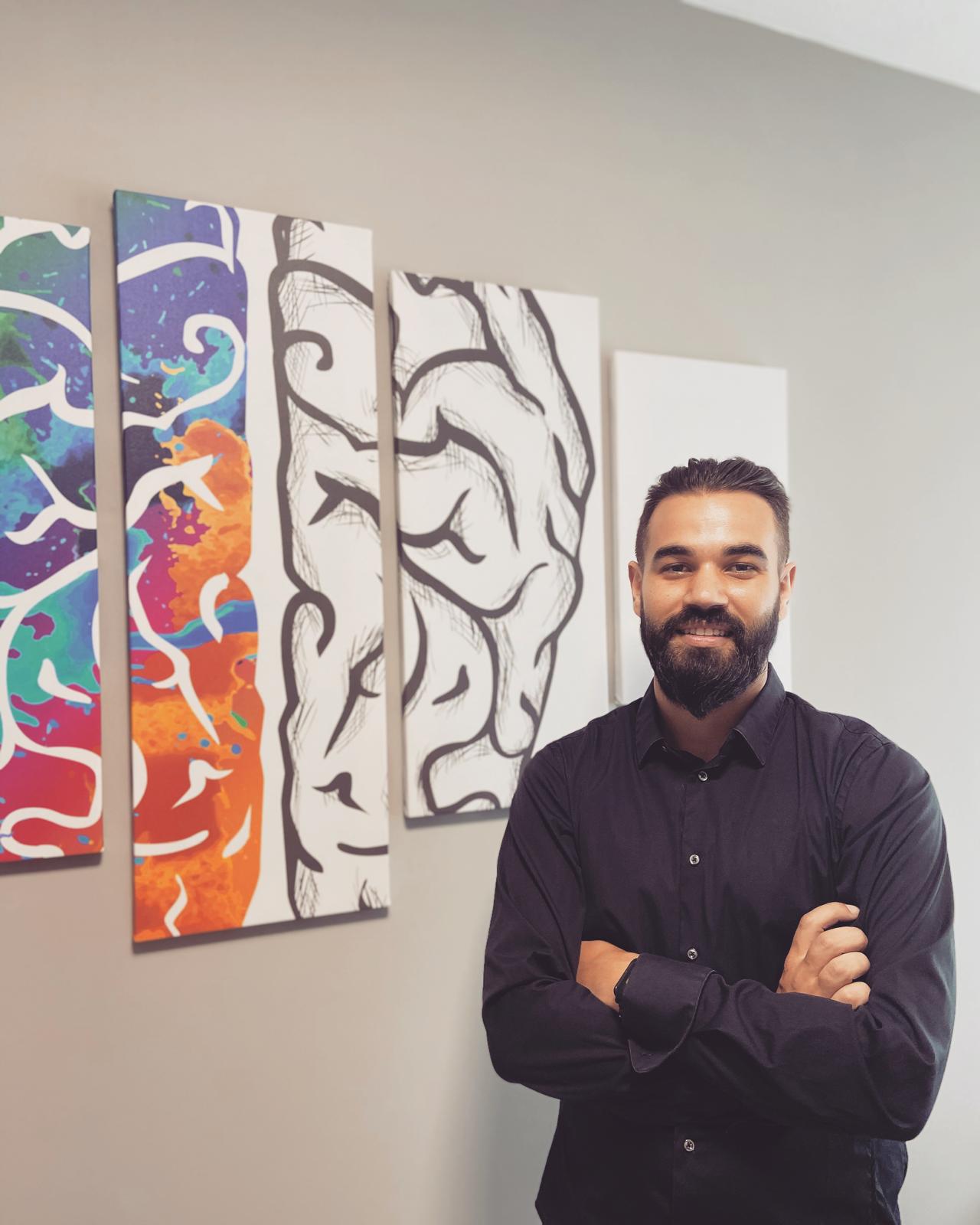
Vicente Pérez Díaz
Psychologist · Reg. AO08585 · Degree in Psychology (Licenciatura), Universidad de Málaga
Vicente practises at Ergo Psicología in Marbella. His therapeutic work focuses on the treatment of addictions in adults and in teenagers: substances (alcohol, cannabis, cocaine, benzodiazepines) and problematic behaviours (screens, video games, online gambling, sexuality). Where the patient is a minor, he also supports the family through the process.
He has twelve years of clinical experience in residential settings prior to private practice: six years at a centre specialised in addiction treatment, supporting recovery processes through every stage, and eight years at a treatment centre for adolescents with behavioural difficulties, working at both centres in parallel for a couple of years. During his degree he also completed an Erasmus exchange at the University of Ghent (Belgium).
Pricing
Teenagers
€50 / 1h
Adults
€60 / 1h
The first session costs the same and carries no obligation to continue. We use it to assess the situation and give you a realistic estimate of the process.
Frequently asked questions about addiction therapy
- How do I know if my child has an addiction problem?
- Warning signs include sudden mood swings, withdrawal from family and friends, falling grades, frequent lying, sleep changes, and loss of interest in activities they used to enjoy. No single sign confirms an addiction, but if several appear together, it is worth consulting a professional.
- How do I know if what I'm going through is "serious enough" to ask for help?
- If you're asking yourself that question, it has probably been on your mind for a while. Don't wait until you hit rock bottom. Addiction is easier to treat while there is still room to act, not after it has already damaged your health, work or family. It's enough to feel that the substance use or the behaviour is no longer under your control.
- How many sessions will I need?
- It depends on the case. Some processes take 8 to 15 sessions, others a longer follow-up, especially when relapse prevention is the priority. In the first session we make a realistic assessment and give you an estimate, not a promise. The pace is something we set together.
- What happens in the first session? Do I have to tell you everything?
- The first session is for me to listen and understand the situation. You don't have to prepare or arrive with everything organised. You share what you can and what you want, the rest will come out over time. At the end I give you a clear picture of what I see and what I would propose. You decide afterwards whether to continue, with no pressure.
- Is everything we talk about confidential? What if I'm a minor?
- Yes. Everything said in the consultation room stays there, protected by professional confidentiality. With teenagers this matters especially: what they share in session is not passed on literally to their parents. Parents receive guidance and recommendations, but not the content of the sessions. That privacy is what allows the teen to genuinely trust and open up.
- What if I don't connect with you? Can I stop or change therapist?
- Yes, and it's a healthy question to ask. You can raise it at any time, without justifying yourself. Therapy works better when there is trust, so if you don't feel it, tell me. Sometimes it's a matter of adjusting the approach, sometimes it's about referring you to another professional. What matters is that the process serves you.
- My child or partner doesn't want to come. Does it make sense for me to come on my own?
- Yes, very much so. The close environment of someone with an addiction has a huge impact, for better or for worse. Working with you gives you tools to support without enabling, to be present without burning out, and to change dynamics that, often unknowingly, feed the problem. And often, when something shifts in their environment, the person ends up asking for help on their own.
- Do you treat cannabis addiction?
- Yes, it is one of our most common referrals, in adults and in teenagers. Cannabis is the most widely used illegal substance in Spain. We work individually and, when the patient is a minor, we involve the family in the process.
- Do you treat problematic screen and gaming use?
- Yes. Problematic screen use (phones, social media, video games, online betting) is a growing reason for consultation, in adults and in teenagers. We do not treat it the same way as a substance dependence: we approach it as a learned pattern that has overrun the patient's life, and we work on the triggers, the limits and the symptoms it is producing (isolation, loss of control, school or work decline, family conflict).
- Do the parents need to be involved?
- It is not mandatory, but it is strongly recommended. Recovery in adolescents is significantly faster when the family understands what is happening and adjusts their approach. We offer parent guidance sessions alongside the teen's treatment, always respecting their privacy.
- How much does an addiction therapy session cost?
- Individual sessions cost €50 for teens and €60 for adults. Each session lasts one hour. The first session is an assessment where we map the situation and give you a realistic estimate of the process.
- Can addiction therapy be done online?
- Yes. We offer sessions by video call for people who live outside Marbella or prefer the online format. Online therapy is equally effective for many addiction cases, especially when combined with regular follow-up.